Gen AI vs Agentic AI
Gen AI vs Agentic AI
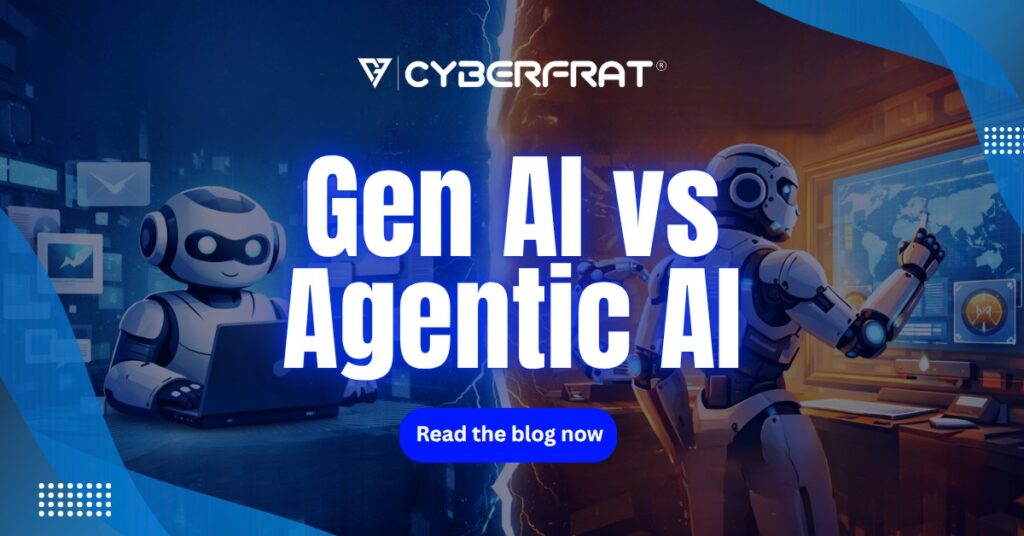
Artificial Intelligence (AI) is evolving at a rapid pace, and with that growth comes new terms that can feel confusing at first. Two of the most talked-about concepts in 2025 and beyond are Generative AI (Gen AI) and Agentic AI; they are related but not the same. While both are powerful, they serve very different purposes, and understanding this difference is especially important for students, tech professionals, and anyone working in AI, cybersecurity, or data science. Let’s break it down in a simple way that’s easy to understand.
What is Generative AI (GenAI)?
Generative AI is exactly what the name suggests; it generates content. This content can be text, images, videos, code, music, or even designs. Gen AI works by learning patterns from huge amounts of data and then creating new outputs based on what it has learned.
For example, when you ask an AI tool to
- Write a blog or email.
- Create an image from a text prompt.
- Generate code for a website
- Summarize a long document.
That’s Generative AI in action.
Key point: Gen AI responds to your prompt. It does not act on its own. You ask; it answers.
Think of Gen AI as a smart assistant who is very good at creating things but waits for instructions.

What is Agentic AI?
Agentic AI goes one step further. Instead of just generating content, Agentic AI can take actions, make decisions, and work toward a goal on its own.
Agentic AI systems are designed like “agents.” They can:
- Understand a goal
- Plan steps to achieve it.
- Use tools or software.
- Monitor results
- Adjust actions if needed.
For example:
- An AI that automatically books meetings by checking calendars and sending invites
- A cybersecurity AI that detects threats and responds without human approval
- An AI agent that manages customer support tickets end to end
Key point: Agentic AI doesn’t just respond; it acts.
You give it a goal, not step-by-step instructions.
How They Actually Work Together
Many people miss one important point when talking about these technologies: Agentic AI does not replace Generative AI; it works with it. Generative AI handles things like language, reasoning, and communication, helping the system understand and create responses. Agentic AI builds on top of this by adding memory, planning, decision-making, and execution. A simple way to think about it is this: Gen AI is the brain, while Agentic AI is the brain + hands + power to make decisions and act.
Together, they make AI not just intelligent, but truly capable of getting real work done.
Why This Matters (Especially in Cybersecurity & IT)
- Cybersecurity
Gen AI helps security teams understand what’s happening by explaining alerts in simple language, writing incident response playbooks, and documenting security events for audits and reports. It reduces analysis time and helps analysts make faster, better decisions.
Agentic AI goes a step further by actively detecting attacks, responding automatically, isolating affected systems, and stopping threats in real time. This reduces damage, limits downtime, and protects systems even when security teams aren’t online.
- IT Operations
Gen AI explains why something broke by analyzing logs, errors, and system behavior, making troubleshooting faster and less stressful for IT teams. It acts like a smart guide that points engineers in the right direction.
Agentic AI doesn’t just explain the issue; it fixes it. It can restart services, apply patches, scale resources, and resolve incidents automatically, often while teams are asleep.
- Data & AI Ops
Gen AI helps teams discover insights by analyzing large datasets, identifying patterns, and explaining trends in an easy-to-understand way. It turns raw data into meaningful information.
Agentic AI takes those insights and turns them into action by triggering workflows, adjusting models, optimizing systems, and continuously improving performance without manual effort.
Risks and Challenges
Both Generative AI and Agentic AI bring powerful capabilities, but they also introduce serious risks that organizations must handle carefully.
- Gen AI Risks
Generative AI can sometimes produce incorrect or misleading information, often called hallucinations, which may lead to wrong decisions. There is also a risk of sensitive data leakage if models are trained or prompted improperly. Additionally, bias in training data can result in unfair or inaccurate content, which can impact trust and credibility.
- Agentic AI Risks
Agentic AI carries higher risk because it can act on its own. Poorly defined goals may cause the system to take unintended or harmful actions. If misused or compromised, autonomous agents could be exploited for security attacks. There are also major ethical, legal, and compliance challenges when AI systems make decisions without human approval.
The Future: Gen AI vs Agentic AI
We are moving from a phase of “AI that talks” to “AI that acts.” AI is no longer limited to generating answers or content; it is beginning to make decisions and take action on its own.
In the coming years, organizations will move beyond simple chatbots and start deploying intelligent AI agents that can manage complete workflows. Cybersecurity will increasingly depend on autonomous AI defense systems capable of detecting and responding to threats in real time. IT teams will also see a shift in their roles from manually executing tasks to supervising, guiding, and governing AI agents, allowing them to focus more on strategy, innovation, and risk management.
Understanding the difference between Gen AI and Agentic AI isn’t just about technology; it’s about preparing for a future where AI doesn’t just assist us but actively works alongside us.
📢 Want to be featured? Fill out the form and let us showcase your journey!