What Happens When AI Enters the Workplace Uninvited?
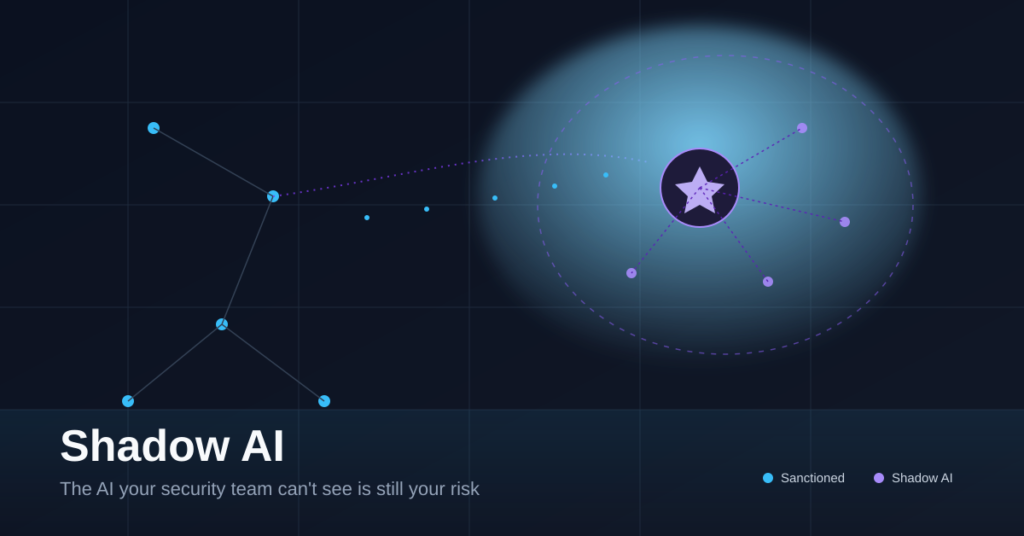
We usually treat AI adoption like something the organization controls rolled out by IT, reviewed by security, approved before anyone touches it.
But that’s not how it actually spreads.
An employee pastes a block of code into a chatbot to debug it faster. A marketer feeds a client brief into a free AI writing tool. A developer wires an AI plugin into a workflow because it saves two hours a week. None of it goes through a review process. None of it shows up on a security dashboard.
And that’s where things start getting dangerous.
This is Shadow AI: artificial intelligence tools, models, or AIembedded features used inside an organization without the knowledge, approval, or oversight of IT or security teams.
It behaves like shadow IT in one sense it lives outside sanctioned channels. But it introduces a risk that shadow IT never did: what an employee types into a prompt can leave the organization instantly, and there is often no log, no audit trail, and no way to know where that data went next.
Understanding how Shadow AI takes hold and why traditional controls miss it is essential for reducing modern attack surfaces.
This article explores five key Shadow AI risks that explain how unmonitored AI use can expose organizations to data loss, compliance failure, and expanded attack surfaces:
- Unmonitored AI tools handling sensitive data outside approved channels
- Data leakage through prompts, plugins, and thirdparty model training
- Compliance and regulatory blind spots created by ungoverned AI use
- Expanding attack surface through unauthorized AI agents and browser extensions
- Loss of visibility into how AI outputs influence real business decisions
Shadow AI shows up across nearly every function engineering, marketing, HR, finance because the barrier to trying a new AI tool is close to zero. That’s exactly why a single ungoverned habit can expose far more than one team ever intended.
How Shadow AI Slips Past Traditional Security Controls
Shadow AI is often dismissed as a productivity quirk rather than a security problem, but it introduces risks that most existing controls were never built to catch.
Most data loss prevention tools were designed to watch known channels: email attachments, USB transfers, cloud uploads. They flag a file leaving through a monitored gate.
A prompt isn’t a file. It’s a few lines of text typed into a browser tab, and to a network monitor it looks identical to any other web request. Seeing that a request went to an AI chatbot’s domain tells a security team almost nothing about what was actually submitted inside it.
Now imagine that request containing a customer database export, a snippet of proprietary source code, or an unreleased financial forecast.
An employee doesn’t need to intend harm. They just need a tool that solves a problem faster than the approved one and once that data leaves, its retention, training use, and onward sharing are governed by someone else’s policy, not the organization’s.
From the outside, it still looks like normal productivity.
How Unsanctioned AI Agents Expand the Attack Surface
Shadow AI isn’t limited to chat interfaces anymore. Browser extensions, IDE plugins, and increasingly autonomous AI agents are being adopted the same informal way one convenient install at a time.
The distinction matters because agentic AI doesn’t just summarize or answer questions it can take actions: querying systems, calling APIs, moving files. An unsanctioned agent connected to real credentials is a shadow AI problem and an identity and access problem at the same time.
Each unmanaged integration adds a path into the environment that security teams don’t know to monitor, review, or patch. A vulnerability in one of these tools like the Copilot promptinjection flaw known as EchoLeak showed how an AI assistant’s own data access can be turned against the organization it was meant to help, without the user ever clicking anything malicious.
That case is worth reading in full: Understanding EchoLeak: the AI threat that needed no click.
The more of these tools accumulate unofficially, the larger and less visible the organization’s real attack surface becomes.
Why Shadow AI Creates Compliance Blind Spots
Regulated industries build compliance around knowing where sensitive data lives and how it moves. Shadow AI breaks that assumption quietly.
When client data, health records, or financial details are pasted into an ungoverned AI tool, that data has left every system the compliance program was designed to cover. There’s no data processing agreement, no retention guarantee, and often no way to prove during an audit or a breach investigation what was shared or when.
Frameworks like the NIST AI Risk Management Framework and the OWASP Top 10 for LLM Applications exist precisely because ungoverned AI use creates risks that fall outside older data protection assumptions.
By the time a regulator asks how AI is governed inside the organization, Shadow AI has usually already answered the question just not the way anyone wanted.
Real-world Scenarios
A developer pastes proprietary code into a public coding assistant to fix a bug faster. The snippet may now be logged, retained, or used to improve a model neither the developer nor their employer controls.
A support agent uploads a customer transcript to a free summarization tool to save time writing notes. The transcript can contain names, account details, and personal information the customer never agreed to share with a third party.
A team connects a browser based AI agent to their project management tool for convenience. The agent now has standing access to tickets, comments, and attachments a permission grant no one formally reviewed or logged.
None of these fail loudly. There’s no crash, no alert, no obvious breach. Just data that quietly moved somewhere it was never supposed to go.
How to Reduce Shadow AI Risk
The goal isn’t to ban AI tools outright that approach reliably fails, because employees simply move the behavior further out of sight. The goal is to make the sanctioned path the easiest one.
Start with visibility. Discovery has to go beyond “is traffic going to a known AI domain” toward understanding what data is actually leaving in that traffic contentlevel visibility, not just endpoint monitoring.
Provide approved alternatives. Governance that offers a sanctioned, equally convenient AI tool reduces Shadow AI far more effectively than restriction alone.
Treat AI agents like identities. Any agent with standing access to systems or data should go through the same access review, leastprivilege, and offboarding process as a human account.
Train for the habit, not just the policy. Most Shadow AI use isn’t malicious it’s someone solving a problem the fastest way they know how. Clear, simple guidance on what’s safe to paste where does more than a policy document nobody reads.
Conclusion
The line between “using a helpful tool” and “exposing the organization” isn’t always visible in the moment.
Shadow AI grows in the small decisions a pasted paragraph, a convenient plugin, an agent connected on a whim. None of it feels risky at the time.
But once sensitive data has left through an ungoverned channel, the organization is no longer the one deciding what happens to it next.
And by then, security isn’t reacting to an attack. It’s reacting to a decision it never got to see.