Why Skills Validation Matters in Cybersecurity
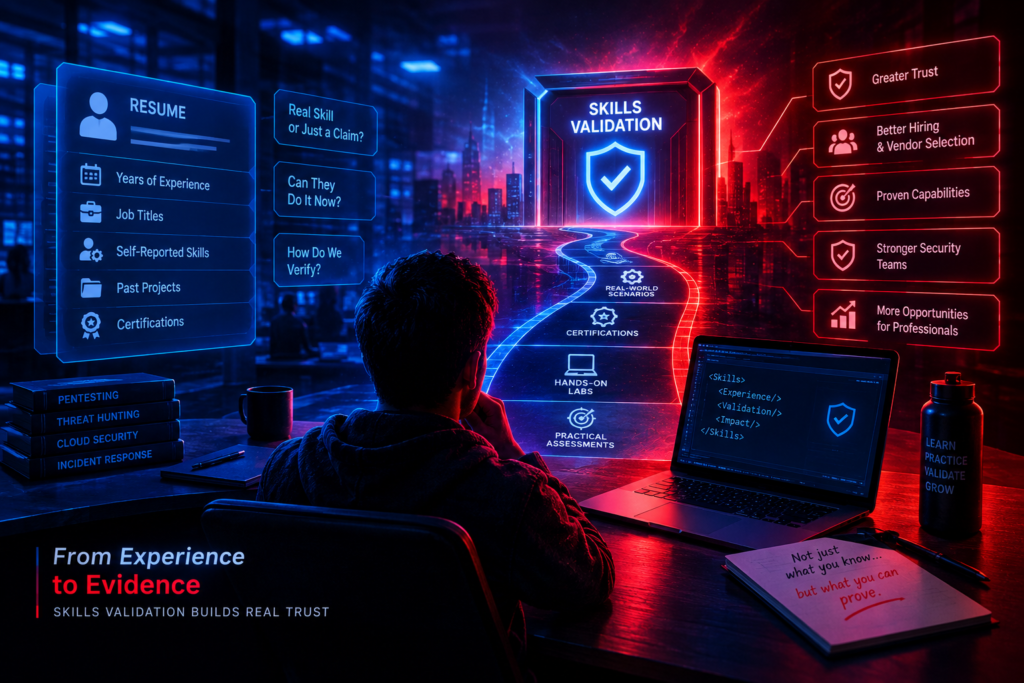
Beyond the Badge: Why Skills Validation Matters in Cybersecurity
Introduction
Cybersecurity is a profession built on trust.
Organizations trust security teams to protect critical systems, investigate incidents, identify vulnerabilities, and respond when things go wrong. Yet one challenge continues to follow both employers and professionals across the industry:
How do you verify cybersecurity expertise?
In a field where technology evolves constantly and new threats emerge daily, experience alone does not always provide the complete picture. Organizations increasingly seek ways to validate technical capability beyond resumes, job titles, and self-reported experience.
This challenge sits at the center of an interesting story involving German cybersecurity company greenhats and a high-profile NFL engagement.
The Cybersecurity Credibility Problem
Unlike many professions, cybersecurity expertise can be difficult to measure from the outside.
A candidate may claim years of experience in penetration testing, threat hunting, cloud security, or incident response. Another may have worked across multiple industries and technologies.
While experience remains valuable, it does not always communicate what someone can currently demonstrate in practice.
This becomes particularly important when organizations are selecting vendors, hiring security professionals, or assigning critical responsibilities.
The question often extends beyond:
“How long have you worked in cybersecurity?”
To something more important:
“Can you demonstrate the skills required for this challenge?”
Why Experience Alone Isn’t Always Enough
Experience remains one of the strongest indicators of professional growth.
However, cybersecurity evolves rapidly.
Cloud environments continue to change. AI introduces new attack surfaces. Security technologies mature. Threat actors adapt.
As a result, organizations increasingly look for evidence that professionals can apply their knowledge in modern environments rather than simply relying on historical experience.
Practical assessments, labs, certifications, and hands-on evaluations have emerged as ways to provide additional confidence in technical capabilities.
They do not replace experience.
They help validate it.
When a Credential Changed the Conversation
This challenge became particularly visible during a cybersecurity engagement involving the NFL.
When the NFL expanded its international presence in Germany, Frankfurt Stadium was selected as one of the host venues. Cybersecurity and incident response capabilities were naturally critical for an event of that scale.
German cybersecurity firm greenhats was considered for the engagement.
While the company had strong technical expertise and relevant experience, it remained relatively unknown to the NFL.
According to an OffSec case study, the conversation shifted significantly when the NFL reviewed the profile of greenhats founder Paul Werther and saw the OSCE³ (Offensive Security Certified Expert 3) credential.
The discussion reportedly moved from evaluating whether the company could handle the engagement to discussing how quickly they could begin.
The interesting aspect of this story is that the certification itself did not create expertise.
The expertise already existed.
What changed was the level of confidence and recognition surrounding that expertise.
The certification acted as a signal.
It provided an externally recognizable indication that the individual had successfully completed a demanding technical pathway and demonstrated advanced offensive security skills.
Certifications act as Signals, Not Guarantees
This distinction is important.
Cybersecurity certifications are sometimes viewed from two extremes: either as mandatory proof of expertise or as credentials with little practical value.
The reality is far more nuanced.
A certification does not automatically make someone a skilled security professional.
Likewise, the absence of a certification does not indicate a lack of expertise.
The value of a well-designed assessment lies in its ability to provide evidence that knowledge and skills have been tested against a defined standard.
In the greenhats example, certifications were not treated as achievements to display on a profile.
They formed part of a broader development strategy that combined training, real-world engagements, mentorship, and continuous learning.
The certification supported the process.
It did not replace it.
The Rise of Practical Skills Validation
The cybersecurity industry is increasingly moving toward practical assessments that evaluate what professionals can actually do rather than what they can simply memorize.
This shift reflects the nature of modern security work.
Identifying vulnerabilities.
Investigating incidents.
Analyzing malicious activity.
Securing cloud environments.
Protecting AI-powered applications.
Responding to active threats.
These activities require execution rather than theoretical understanding alone.
As organizations face increasingly complex security challenges, practical validation is becoming a valuable complement to traditional education and experience.
The focus is gradually shifting from:
“What do you know?”
to
“What can you demonstrate?”
This evolution is particularly relevant as organizations adopt emerging technologies such as artificial intelligence, where new attack techniques, security risks, and defensive strategies continue to emerge at a rapid pace.
What This Means for Security Professionals
For cybersecurity professionals, this trend presents both an opportunity and a challenge.
Technical skills must be continuously developed, tested, and refined.
The most effective professionals combine:
- Practical experience
- Continuous learning
- Industry-relevant assessments
- Hands-on problem solving
- Adaptability to new technologies
The goal is not simply to collect certifications.
The goal is to develop demonstrable capability.
In an industry where trust and credibility are essential, the ability to validate skills can create meaningful advantages for both individuals and organizations.
Ultimately, certifications, projects, assessments, and real-world experience should work together to tell a consistent story about professional capability.
Conclusion
The greenhats story highlights an important reality about modern cybersecurity.
Capability matters.
But the ability to demonstrate capability matters too.
Experience, training, certifications, and practical assessments each contribute to the broader goal of building trust and confidence in technical expertise.
As cybersecurity continues to evolve, organizations will increasingly look beyond claims and credentials alone.
They will seek evidence of real-world capability.
And for professionals, the challenge will not simply be acquiring knowledge.
It will be proving they can apply it when it matters most.
Where Hacktonomy Fits
This challenge is precisely what Hacktonomy aims to address.
Built around practical, industry-relevant assessments, Hacktonomy focuses on validating cybersecurity skills through measurable standards rather than theoretical knowledge alone.
Its flagship certification, HCASP (Hacktonomy Certified AI Security Professional), is designed for security engineers, cybersecurity practitioners, and ML professionals navigating the offensive and defensive realities of the AI era.
As AI systems become increasingly integrated into business operations, organizations need professionals who can understand not only traditional security challenges but also emerging risks such as prompt injection, model manipulation, AI supply chain attacks, and agentic AI security.
Because in cybersecurity, the question is no longer just:
“What do you know?”
Increasingly, the question is:
“What can you prove?”